


Subscribe to get sharp thinking all about ResearchOps delivered straight to your email inbox. It’s free!

How to AI UXR is supported by Strella, a customer research platform that uses AI to run in-depth interviews and generate actionable insights in just a few hours.
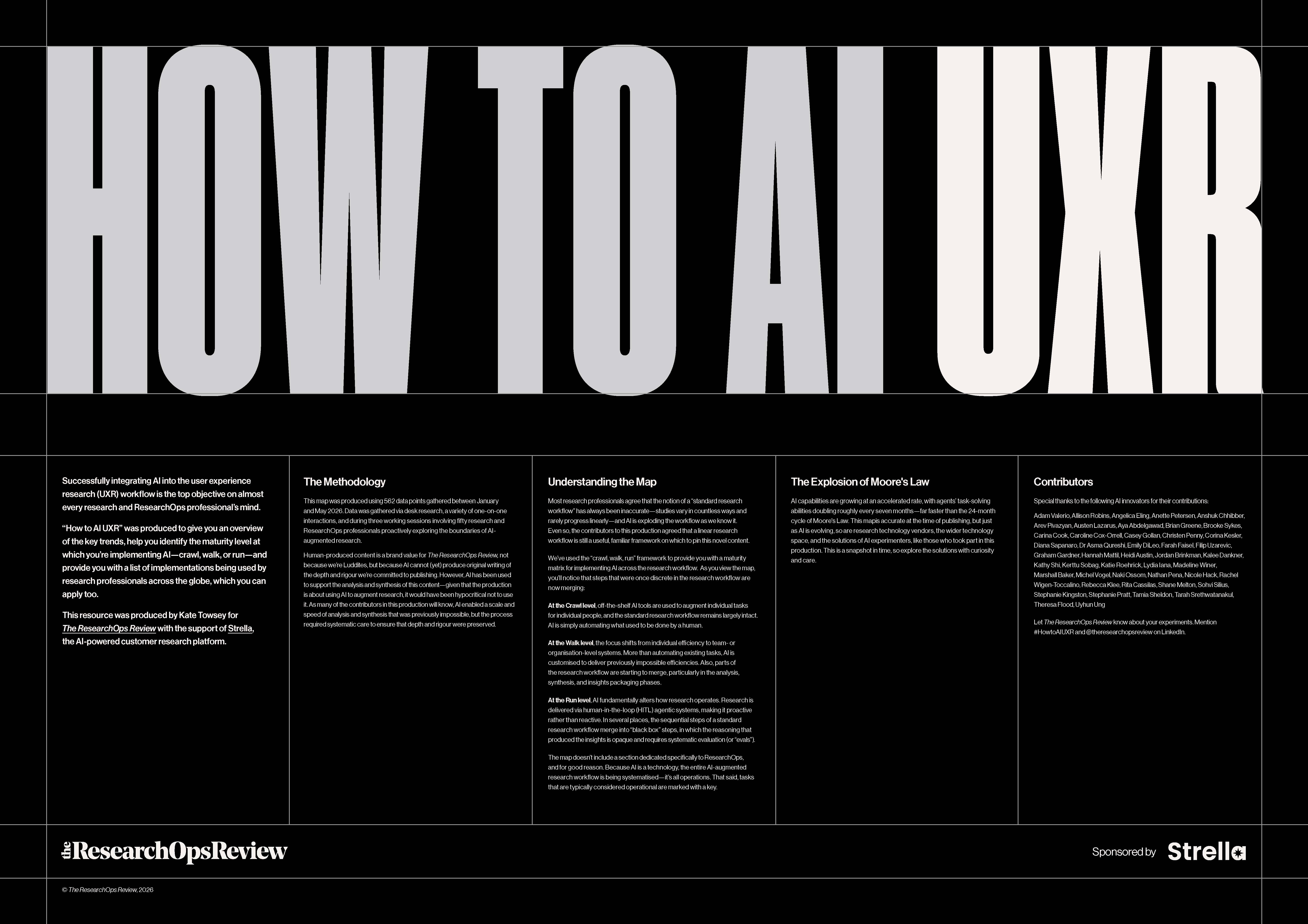
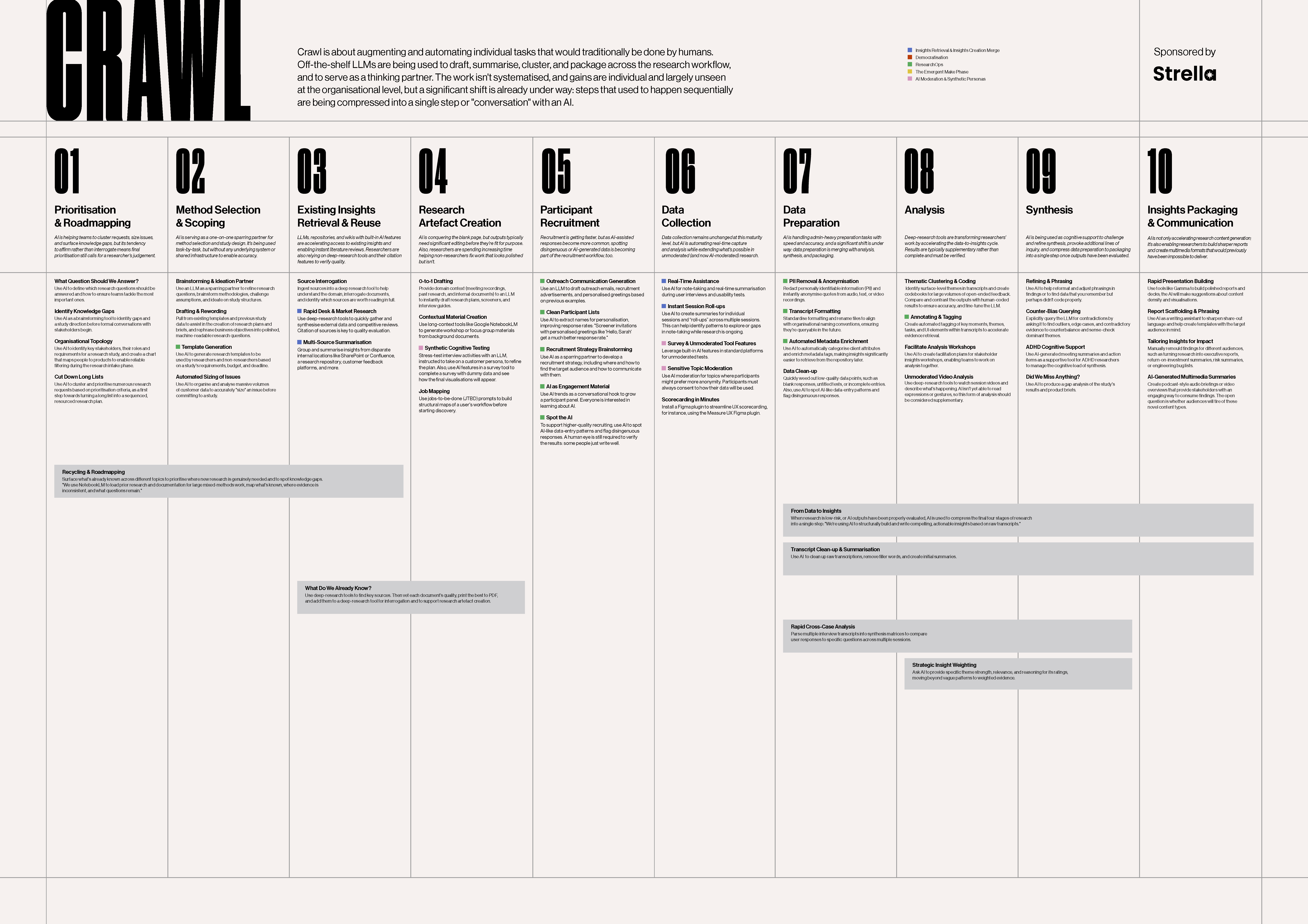
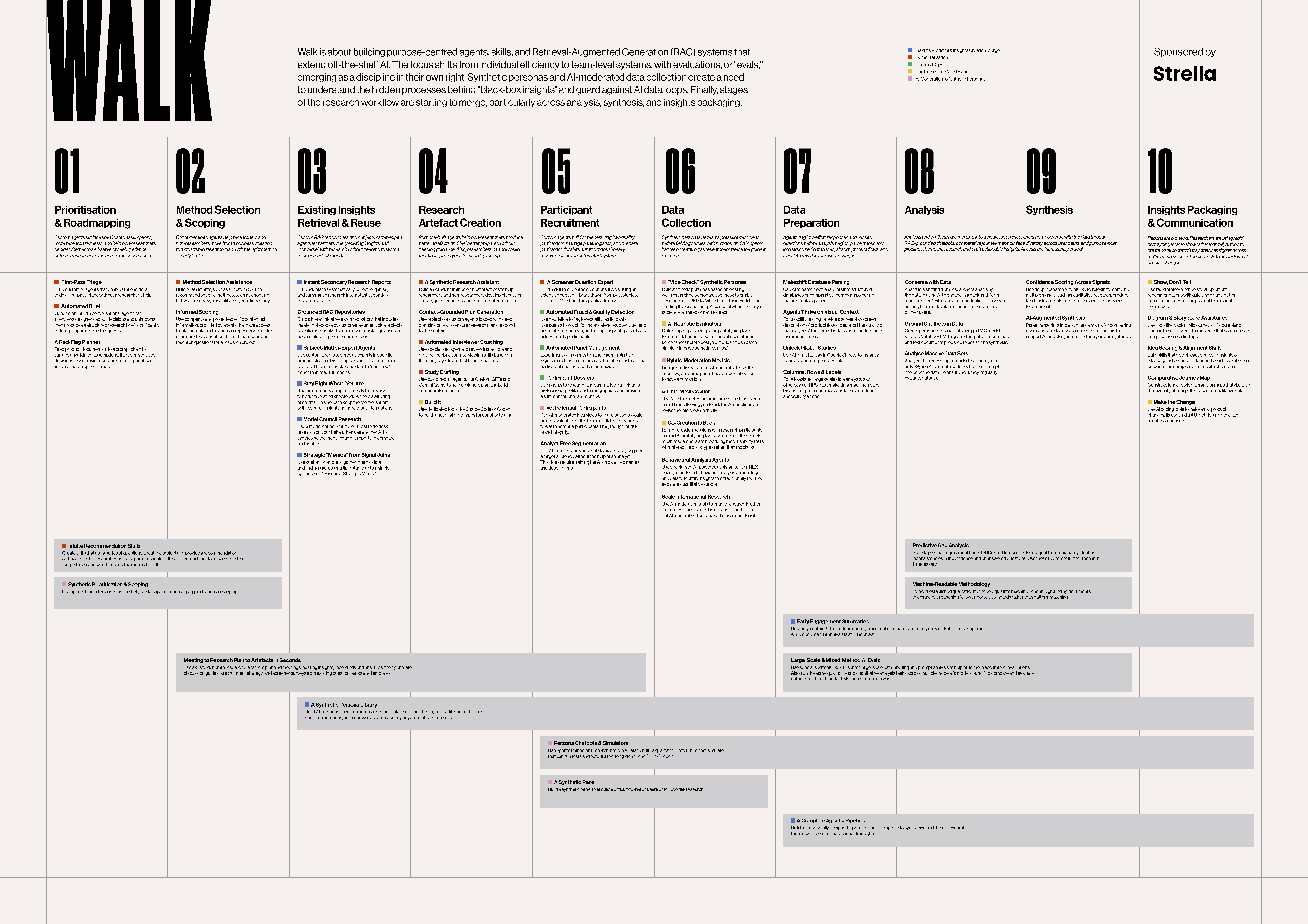
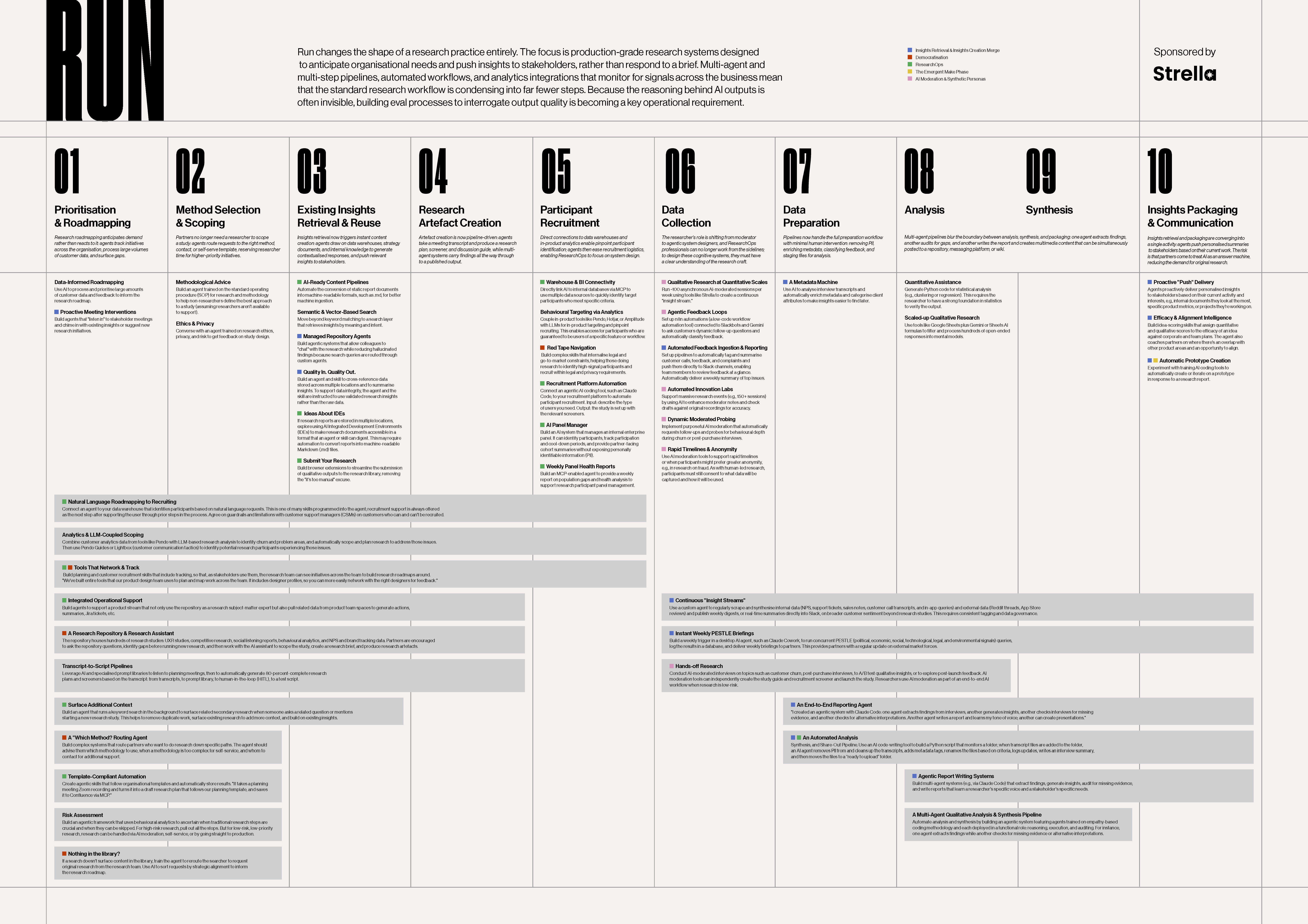
Successfully integrating AI into the user experience research (UXR) workflow is the top objective on almost every research and ResearchOps professional’s mind. How to AI UXR is a map for building AI-augmented research operations. It was produced to give you an overview of the key trends, help you identify the maturity level at which you’re implementing AI—crawl, walk, or run—and provide you with a list of implementations being used by research professionals across the globe, which you can experiment with too.
Download the Map
As we discovered while making this map, the topic is vast and progressing so quickly, both within and beyond the field, that one can hardly keep up. In fact, the Run level detailed on the map is still evolving—it’s a primordial soup of innovation. As such, the How to AI UXR map is a snapshot in time (who knows how long it will remain accurate), but we hope it will set the tone for the kind of systemic, operational work you can (and should) do with AI rather than the “I-Me-Mine-AI”1 approach that has dominated the field.

The How to AI UXR map includes information on how it was produced, how to “read” it, a list of contributors, and a glossary—AI is introducing so many new terms, it can be hard to keep up. As you will no doubt agree, the map is also detailed. The production unearthed significantly more information than could be shared in a single infographic. Apart from introducing the map, this article covers what didn’t fit: key trends, the specifics of AI-augmented research operations, and the downsides that must be managed alongside the significant upsides that AI is offering many intrepid research teams.
The Five Shifts Reshaping UXR
It will come as no surprise that AI is fundamentally reshaping how UX research is done and consumed. But what’s more interesting is how quickly and intrinsically AI is changing the roles of research professionals,2 and how it’s being used to enrich and amplify both human-produced research and research operations.
If there’s one insight the How to AI UXR map aims lands, it’s this: AI’s most meaningful impact on research won’t be a collection of time-saving tactics; it will be the shift from individual work to systems work; from “How do I use AI?” to “How does our organisation build research that is faster, safer, and more reusable with the help of AI?” This shift is particularly well illustrated in the Run level of the map (see page 4). These are the major themes that emerged from the production:
1. Proactive rather than reactive. “The insights are great, but too late,” is fast becoming a complaint of the past. Well-designed AI systems allow research professionals to operate proactively. The focus is now on insight quality management and on predicting what stakeholders will need before they can articulate it. To support this shift, research teams are doing gap analyses across roadmaps, repositories, and recruitment panels, then delivering operations updates, insights, and weekly summaries before stakeholders have thought to submit a request.
2. Conversing with data. Analysis and synthesis are shifting from linear coding and sorting to a reflexive dialogue. As one contributor put it, “The amount of time I spend ‘conversing with my data.’ I think I’ve actually developed a deeper understanding of our users.” Rather than use AI to automate analysis and synthesis, savvy researchers are using AI as a whetstone to sharpen their thinking, query their data for contradictions and edge cases, and surface their own cognitive biases. For more on this topic, read “Calibration Matters More Than Automation: What AI’s History Suggests About Building Agentic Research Systems”3 by ResearchOps consultant George Jensen.
3. The “make” phase. The democratising power of AI means researchers can now more easily bridge the gap between insights and implementation. Researchers are vibe-coding functional prototypes, co-creating designs with participants in real time, fixing low-risk user interface issues in the product, producing on-brand copy, and, most interestingly of all, sharing insights not via decks or reports but in the “language” of designers and product managers: as high-fidelity prototypes. No longer is the democratisation of specialised crafts only a concern for researchers; designers and engineers are now concerned, too.
4. Qualitative research at quantitative scales. AI-moderated sessions are enabling researchers to run hundreds of interviews per week, and AI analysis is allowing them to parse huge qualitative datasets in ways that were previously impossible. For some researchers, that sentence may be enough to keep them up at night, but, rather than create black box research—invisible processes that seem impossible to interrogate—researchers are using these technologies to size issues before they commit to human research, prepare for high-risk human research, or to enable low-risk studies that would previously have been deprioritised. AI moderation is proving to be a valuable lever for research teams, but as with unmoderated research, you must define and implement the right operational guardrails and repeatable evaluation, or “eval,” practices to ensure speed doesn’t deteriorate quality.
5. Insights delivered in multimedia formats. Static PDF reports (another traditional bugbear for research professionals: “Why did no one read my report?”) are being replaced by multimedia content like podcasts, interactive vibe-coded websites, and Retrieval-Augmented Generation (RAG) chatbots that allow research consumers to use natural language to discover what they need to know, when they want to know it. If you’re unfamiliar with RAG systems, McKinsey offers a useful explainer: “What Is Retrieval-Augmented Generation (RAG)?”.4 Which of these multimedia content experiments will stand the test of time—novelty is finite—and the increasing issue of information overwhelm is anyone’s guess. This writer thinks that RAG-based chatbots are the best bet.
ResearchOps Is Becoming Agentic System Design
AI is ultimately a knowledge technology that has made most, if not all, activities within the research workflow systematisable. For this reason, the How to AI UXR map doesn’t include a dedicated section for ResearchOps or, on that note, knowledge management—it’s all systems, so it’s all research operations, and it’s all about managing knowledge. This same evolution is also making research and ResearchOps roles increasingly indistinct. Many researchers are transitioning from “traditional” research roles to almost full-time system design roles. Simultaneously, ResearchOps professionals can no longer focus solely on research system delivery; to deliver AI-augmented research systems, they must now also have a deep understanding of research craft.
That said, six themes emerged that are specifically related to the ResearchOps role, and they’re worth noting here:
1. From support to system design. This transition was already underway well before AI,5 but AI has accelerated it. Rather than offer administrative support, the primary role of ResearchOps and the increasing number of researchers delivering operations, is to build the infrastructure that allows AI-assisted research to happen efficiently and safely across entire organisations. “Run” research professionals (see page 4) are now designing complex agentic systems and repeatable eval processes to support ongoing reliability.
2. Intake, triage, support, and routing. At the Walk level (see page 3), operational systems now regularly include “front door” support bots and agentic intake processes. These systems use custom parameters to offer advice and decide whether a request should be handled via a self-serve template or routed to a human. As one contributor noted, “I’m working on an AI skill this week to act as the intake process for people who do research (PWDR). With certain parameters, such as low or high risk, the agent suggests whether to self-serve or work with UX management on researcher resourcing.”
3. Knowledge management and semantic search. Research knowledge management has been an ongoing challenge for research teams for over a decade, and AI is fundamentally changing the landscape. Primarily, there’s a move from keyword-based search to semantic and vector-based search layers. Repositories trained on research methodology are becoming increasingly hierarchical, and RAG-grounded environments where stakeholders can “converse” with research rather than reading static reports are becoming standard. I built a RAG repository to support the synthesis of the How to AI UXR data.
4. Data-informed learning and development. This is one of the most unexpected and powerful areas for leveraging AI. It’s shifting professional development from generic training to real-time coaching and automated critique systems that analyse research activities against organisational best practices. These tools—often implemented as specialised agents—provide immediate feedback on interviewing skills, identify leading questions in discussion guides, and help non-researchers navigate complex customer archetypes. Interestingly, in the case studies I’ve seen, people seem far more open to constructive feedback from a well-trained AI than from a fellow human.
5. Automation and pipeline integration. Research professionals operating at the Run level are building end-to-end AI pipelines, often Python or n8n-based, to automatically clean transcripts, remove personally identifiable information (PII), enrich metadata, and stage files for analysis the moment a research session ends. Files are also often prepared for intake into the research repository, with human validation. As you’ll learn in the following section, this sort of end-to-end automation requires significant, operationalised mediation.
6. Quality assurance (QA) as a new discipline. AI evals are emerging as a core operational discipline. This includes building systems that enable regular human-in-the-loop (HITL) monitoring of agentic outputs, such as building multi-agent auditing systems in which one agent extracts findings while another independently checks for alternative interpretations or missing evidence. As one contributor noted, “I created an agentic system with Claude Code: one agent extracts findings from interviews, another generates insights, another checks interviews for missing evidence, and another checks for alternative interpretations.” For more on evals, read “Winning the Game of Broken Telephone: A Blueprint for Evaluating AI Across the Research Pipeline” by Lindsey DeWitt Prat.
Seven Risks to Manage as You Scale AI
This map and the contents of this article will no doubt agitate many researchers: “Are you trying to say that AI can do my job?” Many researchers are now embracing AI, and it’s delivering promising upgrades to research, as the How to AI UXR map illustrates. But researchers working at the cutting edge of AI augmentation are equally aware of the critical downsides—not all are technological downsides—and the hard requirement that skilled humans remain in the loop. As a result, they’re building essential “AI antidotes” into their systems. These are the primary concerns:
1. The disintermediation risk. There’s a growing concern that AI-powered “answer engines” will reduce researchers to data aggregators, and that partners will shop for insights that align with their direction of travel rather than commission original research that may contradict it—never mind that it may take substantially more time to produce. An equally important risk is that AI makes research seem so easy that knowledge seekers bypass the essential interpretive scaffolding that makes research findings trustworthy—and that rushed or inexperienced researchers do this, too. None of these problems is new, but AI (the ultimate amplifier) has made these issues more obvious and pressing.
2. Critical familiarisation. Even though AI can process data and produce polished-sounding results, often in moments, experts emphasise that “steeping” in the data remains essential. A well-architected model council (a multi-model research architecture enabling you to simultaneously query several AI models to provide a unified, cross-verified response) may be able to do some evaluation for you, but a direct understanding of the raw data is the only way to guarantee that insights aren’t only accurate but also retain their richness—and truth.
3. Synthetic data loops. When AI study preparation, AI moderation, and even AI participants produce all of the insights (in other words, when human insight is completely removed from research), the risk of unreliable insights is, unsurprisingly, significant. But that doesn’t mean that these tools aren’t handy. To counter synthetic loops, savvy AI users are building systems that provide clear visibility into every stage of the automated pipeline, such as utilising model councils to audit findings and identify alternative interpretations.
4. Fraud and quality. Increasingly realistic fake participants and AI-enabled responses mean that research professionals need to implement both manual and automated checks. One contributor said, “I’ve come across sessions where it appears that participants are reading out AI responses to questions, potentially creating unwanted synthetic data,” while another shared that they’ve seen “increasingly realistic fake participants—even in video and audio.” Ironically, AI is also being used to counter fraud: research professionals use heuristics (rules of thumb) to flag low-quality participants, and agents to watch for inconsistencies, overly generic or scripted responses, and suspect applications.
5. The verification paradox. This is a critical strategic concern: as the volume of AI-generated research increases, the human ability to verify every citation or summary shrinks, leading to a reliance on potentially hallucinated patterns that can’t be unpicked. To counter the verification paradox, researchers are implementing the multi-agent auditing systems already mentioned, utilising source-linked RAG repositories for instant validation, and refusing to skip the human-led data familiarisation stage for high-stakes work.
6. Organisational and contextual blindness. Current AI models don’t understand office politics, organisational dynamics, or the stakes involved in a research study, or which insights will land with specific stakeholders. At the Run level (see page 4), researchers are designing agentic systems grounded in internal strategy and organisational topology while retaining human-led interpretive scaffolding to ensure insights resonate with the specific stakes and social dynamics of their audience.
7. Shallow insights, false speed, and bias amplification. As is now well known, AI outputs look polished but often lack substance, context, and nuance, increasing the risk that teams build the wrong solution, just more efficiently. Savvy researchers are no longer accepting the first summary a model provides. Instead, they command the model to search for the “needle in the haystack” and ask for contradictory evidence, outliers, and edge cases to sense-check dominant patterns. They’re also working to augment human-led research rather than hand over research generation entirely.
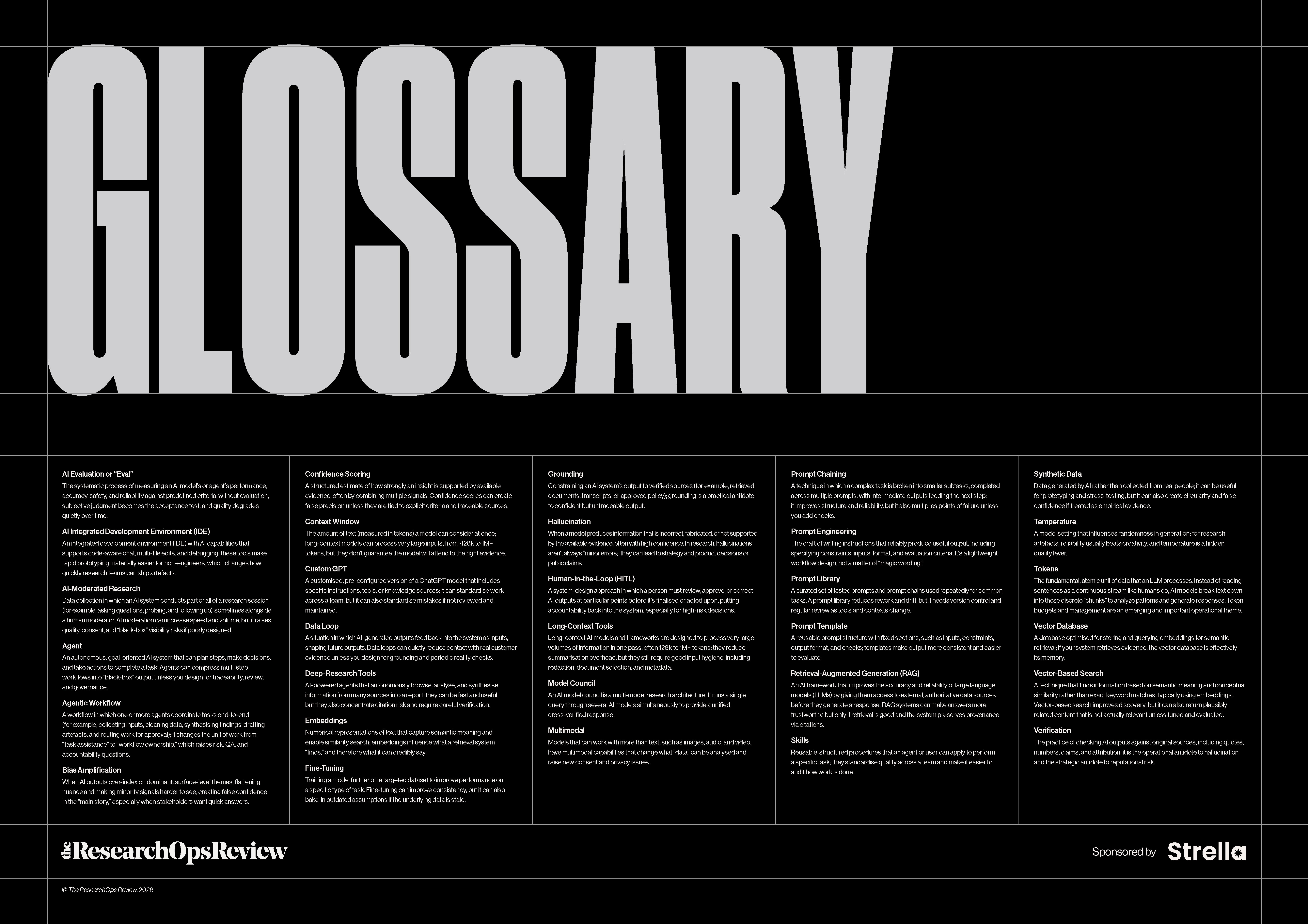
A Map to Help You Navigate, Negotiate, and Slow Down
In producing this map, the feedback has been contradictory: the map presents too much information; it’s overwhelming. The map doesn’t present enough information: we want a list of tools, citations, pace layers,6 and more. As a research professional, you’re likely to know this conundrum well.
We chose to offer a detailed-as-possible map, but one that stripped out as much noise as possible so you can read it as a sort of menu of the ways other research professionals are using AI to augment their workflows. It’s an attempt at documenting enormous complexity in a space that’s moving at breakneck speed, and brings to mind these lyrics from “Headlong” by Queen:
And you’re rushing headlong
You’ve got a new goal
And you’re rushing headlong
Out of control
This map is an attempt to offer some control, a launch pad for negotiating with leadership, and a way to set an AI strategy (while you play and experiment with this new technology, which is an important theme, too). But this map would be even more powerful were you to interpret it and evolve it. The map is copyrighted by The ResearchOps Review, but should you annotate it or be inspired to create something better, please let us know. We would be excited to see what you create, and inspired to keep the conversation going. Please mention The ResearchOps Review on LinkedIn.
Contributors
Thanks to the following AI innovators and makers for their contributions to this production: Adam Valerio, Allison Robins, Angelica Eling, Anette Petersen, Anshuk Chhibber, Arev Pivazyan, Austen Lazarus, Aya Abdelgawad, Brian Greene, Brooke Sykes, Carina Cook, Caroline Cox-Orrell, Casey Gollan, Christen Penny, Corina Kesler, Diana Sapanaro, Dr Asma Qureshi, Emily DiLeo, Farah Faisel, Filip Uzarevic, Graham Gardner, Hannah Mattil, Heidi Austin, Jordan Brinkman, Kaleb Loosbrock, Kalee Dankner, Kathy Shi, Kerttu Sobak, Katie Roehrick, Lydia Iana, Madeline Winer, Marshall Baker, Michel Vogel, Naki Ossom, Nathan Pena, Nicole Hack, Rachel Wigen-Toccalino, Rebecca Klee, Rita Casillas, Shane Melton, Sohvi Silius, Stephanie Kingston, Stephanie M. Pratt, Tamia Sheldon, Tarah Srethwatanakul, Theresa Flood, and Uyhun Ung.
How to AI UXR is supported by Strella, a customer research platform that uses AI to run in-depth interviews and generate actionable insights in just a few hours.
Towsey, Kate. “The Research Operating System Too Few Are Building: Why “I-Me-Mine AI” Isn’t Enough.” The ResearchOps Review, March 5, 2026. https://www.theresearchopsreview.com/p/a-wake-up-call-for-researchops.
We use “research professionals” as a collective term for both research and ResearchOps specialists.
Jensen, George. "Calibration Matters More Than Automation: What AI’S History Suggests About Building Agentic Research Systems." The ResearchOps Review, April 23, 2026. https://www.theresearchopsreview.com/p/what-ais-history-suggests-about-building-agentic-research-systems.
Yee, Lareina, Michael Chui, Roger Roberts, Mara Pometti, Patrick Wollner, and Stephen Xu. “What Is Retrieval-augmented Generation (RAG)?” McKinsey Insights, October 30, 2024. https://www.mckinsey.com/featured-insights/mckinsey-explainers/what-is-retrieval-augmented-generation-rag.
Towsey, Kate. “EP #3: Taking a Platform Approach to ResearchOps.” The ResearchOps Review, August 16, 2025. https://www.theresearchopsreview.com/p/ep-3-taking-a-platform-approach-to-researchops.
Pace layers (or “pace layering”) is a conceptual framework that explains how complex systems, such as societies or businesses, are organized into interacting layers that change at different speeds. Proposed by the American writer and project developer Stewart Brand, the model argues that fast layers drive innovation, while slow layers provide stability.
The typography is just soooo good :)