

Pay-by-Weight or All-You-Can-Eat? Building Self-Service Research Programs That Actually Work
by Luana Cruz

Subscribe to get sharp thinking all about ResearchOps delivered straight to your email inbox. It’s free!

The ResearchOps Review is brought to you by Rally—scale research operations with Rally’s robust user research CRM, automated recruitment, and deep integrations into your existing research tech stack.
Your team is drowning in research requests, stakeholders are getting impatient, and no matter how loudly you advocate for more headcount, the team isn’t growing fast enough to meet the demand. These challenges likely sound familiar—and they’re exactly why self-service research programs, also known as democratized research programs, have become so popular. These programs are meant to empower non-researchers to autonomously access insights and make decisions without constantly pulling researchers away from complex, high-impact work. But do they actually achieve that goal?
In the past five years, I haven’t worked with a single company that hasn’t had some version of a self-service research program. In that time, I’ve noticed that most research teams operate at one of two extremes, both of which create problems for self-service research. Once you understand these extremes and why they prompt most research teams to deliver self-service programs that don’t quite hit the mark, you’ll be able to achieve a better-balanced and more impactful self-service program in the long run.
The Fortress and the Free-for-All
One extreme of research is the “fortress model,” in which every research study must involve a researcher. Before the pandemic, in Brazil at least, many companies had a centralized research team responsible for planning, executing, and sharing research across the company. In this case, researchers were the exclusive guardians of research, and, as such, the only people who received or responded to research requests. Regardless of the research team’s size, it was expected that every researcher knew what research was happening, when it was happening, and how every study should be done. From an operational point of view, it was common to see excessively controlling (not necessarily useful) systems and processes, and the infamous kanban board (see Figure 1) displaying all the research requests to guarantee visibility (and, again, sometimes micromanagement) of all the research that could be done, was being done, or was supposed to be done. There is such a thing as over-operationalizing!

The other extreme is the “free-for-all model.” In this case, the company believes that research is easy or unspecialized, so everyone can—and should be enabled—to do it. This sounds democratic and empowering, but it’s a fallacy. I believe research can be democratized, but it must be done intentionally. We must ensure that the research operations we build to enable self-service research account for people's varying levels of research proficiency, are cognisant of the company’s priorities, and include guardrails to deliver research of the right quality. Because, contrary to popular belief, research isn’t easy, and it does require specialist skills. (If you’re a researcher, you may be nodding your head wildly.)
So how do you build a self-service program that strikes the right balance and actually works? Let’s look at the analogy of dining out, where your choices are: á la carte, all-you-can-eat, or pay-by-weight.
À la Carte
In the restaurant world, the à la carte service model is the gold standard. You sit down at your table, look at the menu, and choose your meal. A short while later, your meal arrives, then you eat and pay, all from the comfort of your table. This experience is comparable to a full-service research experience: a stakeholder submits a research request to the research team. The researcher maps out the study to understand the effort required and the potential impact, then executes it and delivers everything necessary to satisfy the request—hopefully before the stakeholder has lost their “appetite!”
This model often works well until the number and complexity of research requests increase (see Figure 2), whether due to greater product complexity or more stakeholders requesting research, or, to go back to the restaurant analogy, stakeholders ordering more than they can eat and then leaving the appetizers, drinks, and dessert on the table. You know the drill.
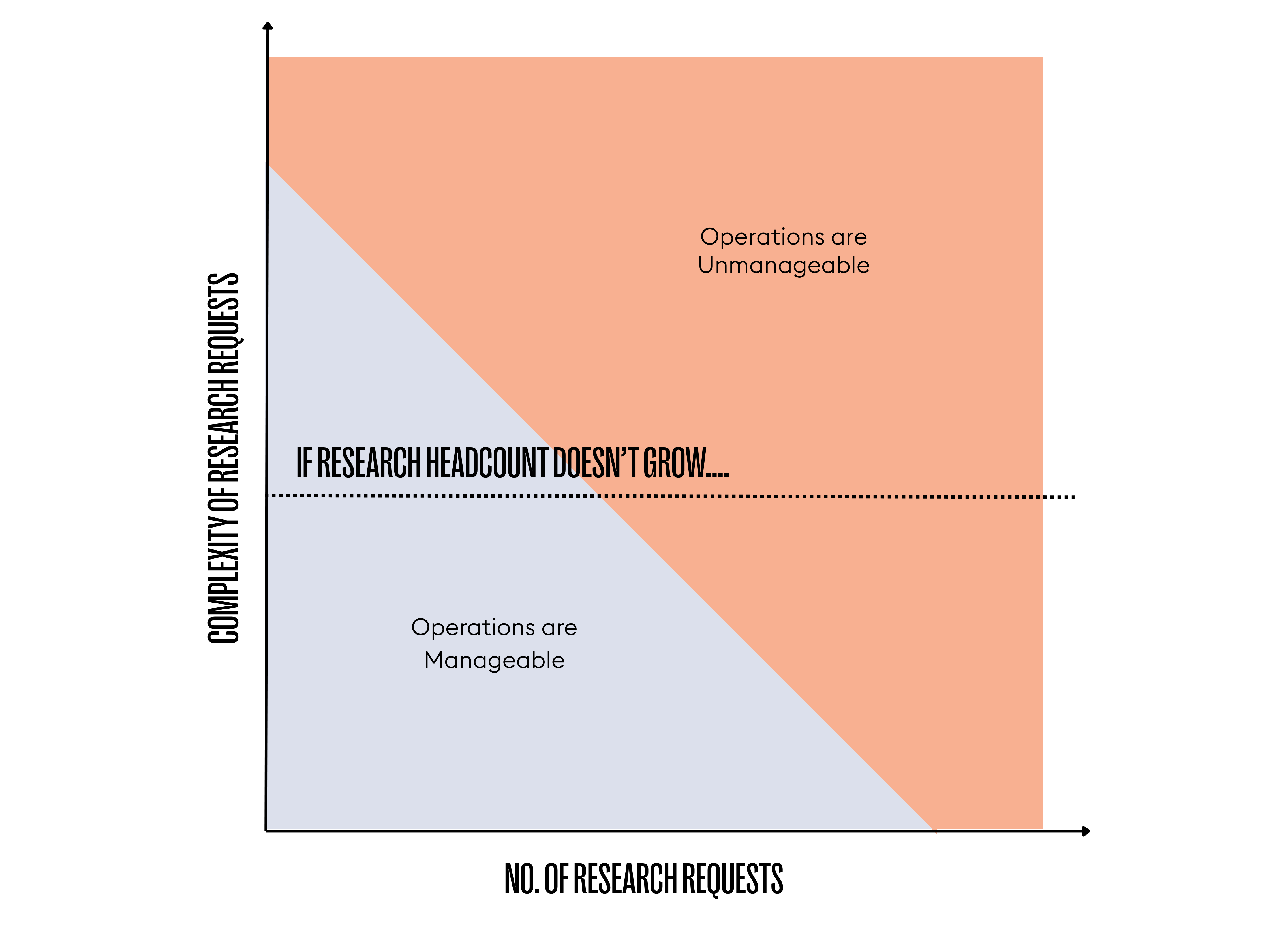
Even if you’re advocating for research and research operations headcount daily, it’s common not to grow at the same pace as demand—in recent times, layoffs mean that your team might even shrink in the face of growing demand. Consequently, researcher-to-research-study ratios can become surreal: 1:10, 1:15, 1:30, and beyond. In this context, even the most effectively run research teams—those with the most sophisticated systems—won’t be able to meet the demand. So, what’s a research or operations leader to do?
Just as you might find in a restaurant kitchen that’s backed up on dinner orders, the most logical and common next step is to choose which requests the research team will—and won’t—execute. In other words, the team sets up operations to triage requests. They prioritize. But then what happens to the deprioritized research studies? To address those, the next logical step is to either create systems that empower non-researchers to conduct deprioritized research (basic self-service research) with guardrails and support, or let deprioritized requests simply become unprioritized and stand by as people contact customers and conduct interviews solo. But without support or guidelines, the typical result is poor customer outreach, poorly executed customer research, and even poorer product decisions.
If you find yourself in this scenario, you’re not alone. It’s a common experience. If you do decide to set up a self-service program, there’s one crucial point that you must consider: make sure you’re not just scaling practices to accommodate as many people as possible for the sake of scale, and that your self-service program ensures high-quality research outputs. And for that to happen, you’ll need to build a system that provides value to the right people in the right parts of the business, and you’ll need to choose the right operating model.
Dining That Scales
In Brazil, we have several restaurant operating models. Two of them closely resemble self-service research programs: rodízio (similar to all-you-can-eat; rodizio means “rotation” in Portuguese) and quilo (“kilo” or pay by weight). At rodizio diners, there’s an island of amenities in the center of the restaurant, including salads, sides, and desserts, to which you can help yourself. But waiters also bring a variety of foods, usually meats, to the table throughout the meal until the customer signals that they’ve had enough. There are very few choices for diners (as stakeholders) to make, and, more importantly, they serve themselves. But the rule is clear: they can eat as much as they want, which guarantees that more food (or research and operations) must be available to satisfy their needs and goals. Often, diners wind up taking advantage of this model—they eat as much as they can eat, and more than they should!

All You Can Eat
In many of the self-service research models at companies I’ve worked with (both Brazilian and international), an “all-you-can-eat” research operating model was in place. Everyone could do all kinds of research, and everyone had access to everything. In restaurant terms, the most stringent rule was to use a plate and a plastic glove, and the latter was treated as optional! This is democratization in the truest sense of the word. If you operate in this way, you’ll find yourself creating and maintaining a massive amount of documentation, and endless possibilities for setting up and doing research from diary studies to unmoderated research, to field work and surveys, for an endless number of people. At this point, the natural response is to hold training sessions to try to teach (in just an hour or two) what researchers have learned over years of dedicated work and study.
This type of self-service program will keep you busy, and you’ll feel like you’re delivering a lot of value, at least initially. But there’s a catch: these sorts of programs create the illusion that everyone is doing research and is capable of doing everything required to do research well—or well enough. The truth is that research and ResearchOps teams often need to help organise the research and explain (and re-explain) the basics to people who couldn’t absorb the extensive training or documentation. As a ResearchOps professional, I’ve often ended up running recruitment for all of these studies because we didn’t want to open the door for people to cause damage, say by randomly calling clients without a specific scope or script of what they want to discover or, even worse, without checking if they’ve agreed to being contacted. We also regularly needed to upload research data to the repository because stakeholders failed to document research outcomes, let alone share them—an expensive and inefficient issue in itself.
In short, these kinds of self-service research programs create an illusion of self-service, with little self and a lot of service.
Pay by Weight
In a pay-by-weight restaurant, you still have the freedom to choose from a very wide variety of menu items, but you pay based on the amount, or weight, of the dishes you choose. Dishes can get absurdly expensive if you want everything, and the scale will shock you before you even take your first bite!
If you make every option and resource available for a flat fee—or no fee—people won’t think twice about using them, with or without intention. But if you make a wide variety of options and resources available, all with clearly associated costs and impacts, people tend to choose carefully, and they’re more likely to be intentional about finishing what’s on their plate. It’s this sense of responsibility and self-awareness that we want to make obvious to someone who isn’t (and perhaps never will be) familiar with research and all of its nuances…and costs.

“Research is easy” is a phrase that’s unfortunately become ubiquitous, perhaps in part because, as research and ResearchOps professionals, we’ve spent a lot of time taking responsibility for the hard part of running research. We make it look easy, making it possible for the people who are doing the research to smile and wave behind the camera at the participant. It’s on us to articulate and manage the sense of responsibility and cost implications of the systems we build. None of these self-service models is inherently wrong, but expecting a single approach to serve everyone or every situation is nearly impossible.
A Case Study: Different Menus for Different Diners
In 2021, I was working as a ResearchOps analyst in a team that was small and decentralized, and I faced a significant challenge: participant recruitment was hindering people from conducting research and forcing them to devise alternative methods for gathering insights. It was a time-consuming and costly process for my team; resources we couldn’t afford to waste. When confronted with a complex problem like this, my strategy is to simplify what I can, automate what’s complex (and automatable), and establish separate structures for teams with varying levels of expertise.
So, I first mapped out the system, identified the problems, and isolated the main pain points. This led to a solution with two distinct tracks:
The first track was tailored for my research team, the experts. It involved creating a sophisticated structure to manage and maintain our internal research panel, including different access levels and control mechanisms. As the panel grew, the focus shifted to acquiring the tools needed to scale.
Simultaneously, I developed a parallel journey that supported non-experts to utilize the same solution with reduced complexity and less direct control over its operation.
If you’re delivering a self-service program, the trick is not to simply create a dumbed-down version of the researcher’s self-service journey. Instead, or in addition, create a journey that’s specifically designed for those who will only consume the basics, or for those who can’t fit sushi, barbecue, and falafel on the same plate.
The solution I described ultimately saved approximately R$1,500 (US$275) per project, a cost that adds up when the organization is running hundreds of projects per year. The system gave people doing research the appropriate levels of autonomy and access to the participant panel we had created, which drastically reduced the recruitment time from two weeks to just a few hours, eliminating the need for full-service, hands-on recruitment support. We learned that acknowledging different levels of research maturity among teams is not a weakness but a chance to develop different ways of working that can strengthen the system and scale research.
Your self-service research program should mitigate an imbalance between capacity and demand. It should ensure that different research journeys can take place in the same environment, with various options for people with different needs and skills, and crucially, different budgets and levels of priority. Finally, while it may not be obvious, we can learn a lot from other industries and their models for scaling and satisfying appetites—even restaurants!
Sponsor and Credits
The ResearchOps Review is made possible thanks to Rally UXR—scale research operations with Rally’s robust user research CRM, automated recruitment, and deep integrations into your existing research tech stack. Join the future of Research Operations. Your peers are already there.

Edited by Kate Towsey and Katel LeDu.
 | A guest post by
|
Great points. I’ve been on resource-constrained teams that swung between “fortress” gatekeeping and “free-for-all” chaos. To extend the restaurant analogy: food-safety first: ethics and privacy are non-negotiable, then label costs, risk, and what happens next so teams choose intentionally and avoid rework.