

Your Best Work Won’t Speak for Itself: Tried-and-Tested Sales Tactics for ResearchOps Professionals
by Glenn Familton

Subscribe to get sharp thinking all about ResearchOps delivered straight to your email inbox. It’s free!

The ResearchOps Review is brought to you by Rally—scale research operations with Rally’s robust user research CRM, automated recruitment, and deep integrations into your existing research tech stack.
I started my career selling surgical cameras for keyhole surgery, then sold grand-piano-sized blood analysers that could process hundreds of samples a day for every blood parameter you could think of. For the last twenty years, I’ve worked in cardiac operating theatres in a part of the heart surgery world called electrophysiology, both as technical support during procedures and as a salesperson. Essentially, a day in the “office” for me involves collecting three-dimensional data of a patient’s heart mapped in real time (see Figure 1.0). During the procedure, we analyse the patient’s heart anatomy, tissue voltage (viability), and, most importantly, the direction of travel of the heart’s electrical current. Using this data, the physician performs small ablations, or burns, to intricately adjust the flow of electricity in the heart during fast heart arrhythmias. In short, if your heart occasionally beats faster than you would like, the people I work with can fix it.

At this point, you might be wondering why a sales guy who helps fix hearts is writing an article for The ResearchOps Review, and it’s a good question. Fifteen years ago, when I was selling one of these systems to the cardiac department of a hospital, I learned a primary lesson that helped me become an award-winning salesperson, not just a good one. When I started working with user experience professionals in 2024—a story for another time—I realised that the sales tactics that had worked so well for me in medical sales were equally valuable in helping research professionals show their impact and value, too.
In this article, you’ll learn why sales is not just for salespeople. I’ll share a simple approach for how you can articulate (and sell) the value you’ve delivered, or want to deliver, how to communicate your achievements so they land with your key audience, and how these tactics will help you turn stakeholders into champions.
Selling Isn’t Just About Transaction, It’s About Transformation
I have an excellent track record in medical sales: I sell US$200K hardware, large magnetic-based sensors, energy generators, and steerable catheters—all of which provide hundreds of thousands of dollars in ongoing sales revenue to my employer. To sell this system to the hospital, I need to convince the specialists involved that it’s the best choice; the purchase may also need to be approved by a committee of experts, and, finally, the annual operating costs must be signed off by the hospital’s finance department. This process can take six months or more (a timeline that will sound familiar to ResearchOps professionals) and must be completed with every hospital that plans to use our system. It’s no easy task!
Fifteen years ago, I’d successfully juggled all of these requirements and was ready to close a deal, but there was a perplexing problem. My own team didn’t share the same sense of priority for delivering quotes, bundling agreements, obtaining internal sign-off, and meeting with key stakeholders. This was a great deal for the company, so why weren’t my colleagues jumping on board? In this instance, timing was everything, so the deal was at risk. That’s when I realised the importance of in-house sales. I was taking my customers on a journey of increased success—I’d successfully sold the hospital staff the picture of increased profits due to shorter procedure times and a better reputation due to fewer complications—but I had completely ignored the job of selling the importance of the agreement to my own colleagues.
This is key for research and ResearchOps professionals because, as knowledge workers, your value is measured (frequently subjectively) by your stakeholders and colleagues. In a corporate environment, great ideas and excellent work without enthusiasm from a team or backing from stakeholders are as good as if they never happened at all. So if you don’t sell the value of your insights or your research systems, or effectively prove a successful track record, you’ll be fighting to achieve your full potential—and sometimes to keep your job.
It’s often assumed that sales is primarily about signing deals or convincing someone to buy something, and it is. But it goes beyond the transactional—it’s also about getting someone onboard, or, put differently, helping them see how the exchange will transform their impact, approach, success, and outcomes.
That moment when the penny dropped fifteen years ago, the hospital needed a custom agreement, but the typical turnaround for creating this type of agreement would have far exceeded the window available to close the deal. By writing an elevator pitch outlining the needs, features, and benefits tailored to our internal finance, legal, and management teams, I was able to start the process. As a result, I got the agreement approved in just one morning. Not only that, but everyone now understood why we required a non standard agreement, and because they played a special part in putting it together, became invested in the outcome of the sale. This sale made my work visible to many levels of management and gave me easier access the next time I needed something, all because I asked my colleagues for a favour in a way that brought them on the journey.
Research operations is an emerging role; few stakeholders fully understand its scope and purpose, and much of the work is infrastructural and can take time to show results. Plus, you’ll often require cross-functional collaboration to achieve your goal. The sales tactics I’ll share in this article are crucial to addressing these challenges and going beyond transaction. But if you’re a research, product, design, or marketing professional, read on, because you’ll be able to leverage these insights to get buy-in and boost your impact, too.
Sell Your Work In Thirty Seconds, or the Art of the Elevator Pitch

Imagine you’re at the office and you step into the elevator only to walk straight into your boss’s boss, someone who makes decisions about your role but doesn’t really understand what you do. Or perhaps you work remotely, and you find yourself on a call with an executive for thirty seconds before anyone else arrives, and they ask what you’re working on. After a five-storey elevator ride, or a remote scenario equivalent, would they walk away thinking that your team offered good value? Would they ask for a follow-up meeting to discuss allocating additional funding to support your work? Would you be able to succinctly articulate the crux (and value) of what you do?
I’ve run several workshops1 for research and ResearchOps professionals, and most people struggle to define their goals in a way that shows benefits not only from their perspective but also for the business’s leaders. Workshop participants are often caught off guard when they have to explain their work to a team that doesn’t understand the value of research or research operations—they even struggle to explain it to each other. This is a huge problem: if you, the person who is most up to date on the initiatives you’re working on, can’t articulate what you’re doing in a way that’s easily understood, how will your work ever be valued or understood by the busiest people in the organisation? Let alone getting your colleagues onboard.
Objections I’ve heard at this point range from: “but it’s my manager’s job to promote my work, not mine,” or “I send senior leaders a monthly report, which they should read,” to “they’re running the organisation, so it’s on them to keep up to date with what we do,” or “this initiative is important for the user experience or for ethical reasons, but they just don’t get what we do.” And maybe some (or most) of that is true, but the reality is, if you want your work to get noticed and be valued, it’s up to you to do the selling by communicating it in such a way that your voice is heard. For many people, it can feel daunting, but there’s a straightforward framework from the sales world that makes it much easier to do.
Crafting Your Elevator Pitch: Needs, Features, and Benefits
Imagine you’ve identified a need to simplify the consent process for research participants. The current consent form isn’t written in plain English (it’s ten pages of legalese) and isn’t available in multiple languages, which increases the dropout rate among carefully screened, hard-to-reach participants from enterprise companies, costing the organisation time and money. Perhaps the consent form also doesn’t meet accessibility requirements or comply with new regulations and standards, which, if not amended, could cost the company millions in data privacy fines or lead to the loss of government contracts. So, you make it a priority to update the consent process, which takes several months and a lot of your and the legal team’s time.
To get buy-in for this initiative, you set up a meeting with your manager and prepare a pitch, covering three critical components: needs, features, and benefits. Now, most people can articulate why something is needed (a problem to be fixed or an opportunity to benefit from) but few can articulate the features (how you’ll fix the problem or leverage the opportunity, and what the solution will do) and benefits (how your solution will generate revenue, save money, or manage risk for the company) in a way that appeals to the person they need to get buy-in from.
So, let’s take the need as previously outlined (updating the consent process)—that’s the obvious bit—and add the features and benefits.
Needs. The current consent form is overly complicated, leading to a higher-than-average dropout rate amongst hard-to-reach enterprise participants. It also doesn’t cater to participants living with disabilities, slowing down accessibility research and putting government contracts at risk. We’ve set this quarter’s goal to rework it. This will require an allocation of 𝖷 hours of internal time across operations and legal, and 𝖷 dollars to achieve.
Features. We’ll create a simplified, one-page consent form in easy-to-understand language suitable for 90 percent of enterprise participants, so they won’t feel the need to run it by their legal department before taking part in a study. This will halve the number of dropouts for every fifty participants recruited.
Benefits. Most people forget to share the benefit of doing something, but it’s the most important part! Within six months of deployment, we’ll have recouped the investment cost by reducing dropouts by 𝖷, saving 𝖷 recruitment hours currently wasted on dropouts, and by speeding up research delivery by 𝖷 weeks per research study.
This is your elevator pitch: a succinct statement that gets to the point and outlines the needs, features, and benefits in a memorable format. It might not contain every detail or metric, but it should communicate the basic idea clearly and boldly.
You can use this format to sell the benefits of a past achievement, or to propose a new project to secure buy-in, headcount, or funding—or all of the above. You can also adapt your elevator pitch to share in a one-on-one, send in a monthly report, share via a DM, or to fill the thirty seconds in which you found yourself face-to-face with your boss’s boss in the elevator (or onscreen). It’s happened to me before!
Without practice, speaking a pitch out loud is awkward and even hard; it’s not something that comes naturally to most people. But once you see how effective it is, you won’t want to communicate your idea any other way. You can bring your own style to it, too; just make sure to keep it succinct and stick to the basic format. It’s a great idea to practice in private with a friend, or announce to your manager that you’d like to get better at this and ask if they’re willing to coach you. They’re sure to learn something from you, too.
This elevator pitch, by itself, is a strong message and a great way to frame your work in a simple, memorable way. But you can take your elevator pitch one (important) step further by tailoring it to the person from whom you need to get a “yes.”
Tailoring Your Pitch to Your Audience

Consider the personality of whom you’re pitching your idea to. Do they care about data? Are they always looking for wins that can be advertised to the wider organisation, perhaps even helping them gain a promotion? Are they often more interested in the social credit—the story or the opportunity for collaboration—behind an idea? Or are they typically interested in a concise summary so they can move on to the next thing?
I don’t like leaning too heavily on generic personality frameworks—the Myers-Briggs Type Indicator (MBTI), Gallup’s StrengthsFinder, and the Enneagram Test are among the best known—and here’s why:
Personality frameworks are often overcomplicated. For instance, the Myers-Briggs has four preference pairs and sixteen different personality types, such as ISTJ, ISFJ, INFJ, and INTJ. If you have to spend too much time trying to decode the personality type of the person in front of you, you might miss your moment.
There’s a tendency to lump people into one category. The reality is that people’s personalities tend to change depending on the situation. For example, when I present technical data on product safety or patient outcomes, the doctors I work with are data-oriented, so I lean into the details. But that same doctor will become a decisive “driver” if an emergency arises during a procedure, which makes sense!
Besides, almost all of these frameworks hinge on the same four primary professional personality types: the results-driven person, the data or analytical type, the storyteller or people person, and the “expressives” or visionary future thinkers.
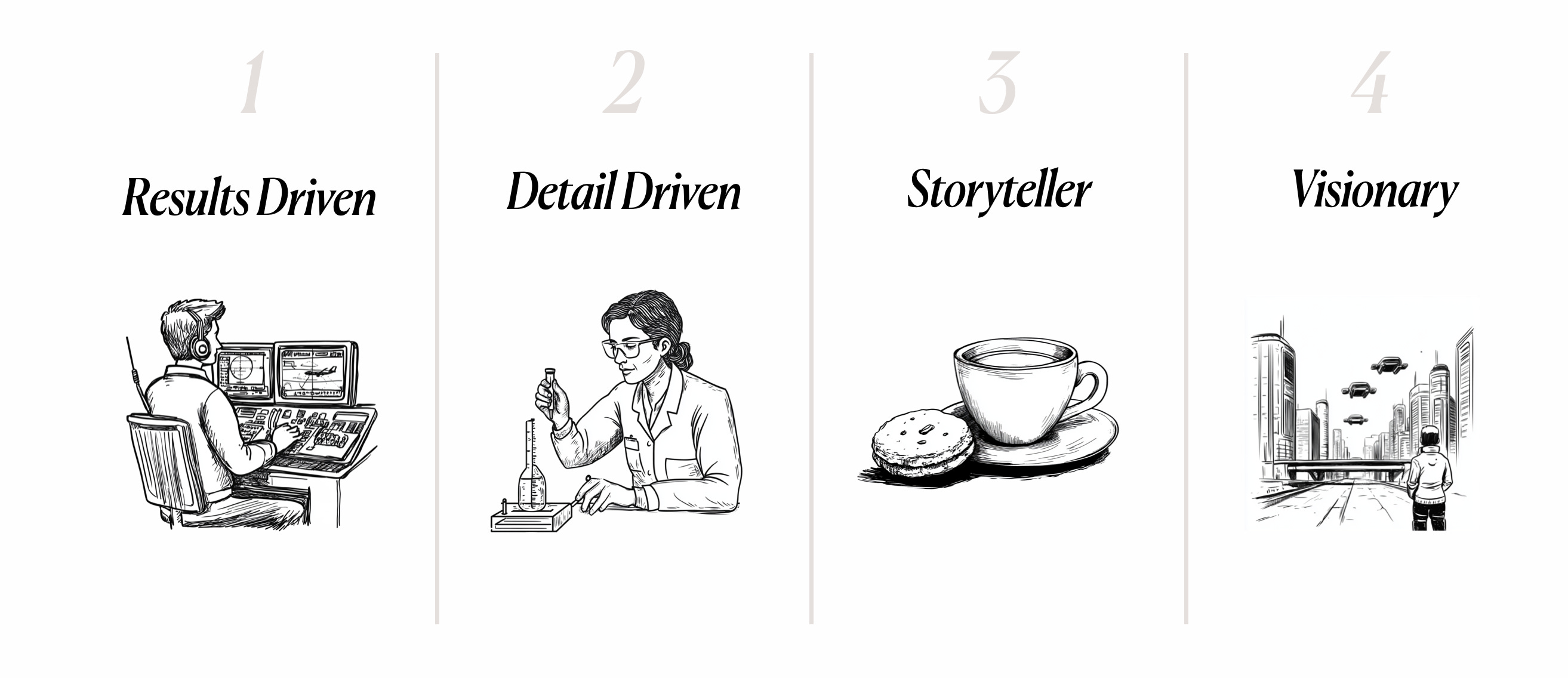
While they will never capture how extensively different we all are, these primary personality types (see Figure 2.0) can help you understand how your key stakeholders lead, collaborate, and make decisions in the workplace—and, of course, how to sell them your ideas.
A driver or results-driven person is typically time-efficient and a logical planner.
A detail-driven person is focused on the data and finer details; they want to know everything.
A storyteller or people person is typically a supportive, relationship-driven team player.
An expressive, future thinker is typically a visionary and creative influencer.
If you’re pitching to a results-driven person (a time-efficient, logical planner), you want to be brief and get to the point. For a detail person, you might share your elevator pitch, then add, “I’ve got a lot more detail to share. Could I book a time to show the highlights from the data, so we can dive deeper where you’re most interested?” For a storyteller or people person who’s, say, looking for wins that can be advertised far and wide, you might offer to pass on a one-page win-focused summary, which they can share at their next team or management meeting, or better still, offer to present it yourself. Finally, for the visionary, don’t limit the benefits of what you have achieved to the immediate future; draw a picture that shows further progress down the line—these people love to hear about your five-year vision.
A concise elevator pitch that focuses on needs, features, and benefits, combined with a tailored approach based on personality type, will take you far. But even with all this preparation, it’s worth remembering that what you wanted to say, what you said, and what your audience heard don’t always align.
What You Wanted to Say, What You Said, and What They Heard (and Didn’t Hear)
Several years ago, I worked as a skydiving instructor, taking people on 15,000-foot skydives. They received a full day of training, then jumped out of a plane for a fifty-second freefall before opening their own parachutes. As scary as this sounds, there would be an experienced instructor, like me, on each side of the student, holding them upright, so if the student curled up in a ball of fear (which sometimes happened), we’d hold them in the correct position, and they’d generally acclimate in time to open their own parachute (see Figure 3.0). The student would then float to the ground and have adrenaline-filled stories to tell.

Before the jump, I would train the student on the exit procedure—how to jump out of the plane—and ask them whether they understood. The answer was almost always “yes.” I then asked the would-be skydiver to explain the exit procedure back to me. On more than one occasion, they would ask, “Actually, can we go through it one more time?” They were literally going to leap out of a plane for the first time, and hadn’t listened closely enough to understand what to do!
The lesson is this: What you want to say, how you actually say it, and how what you say is interpreted are all entirely different things. This is a highly applicable lesson, whether you’re training adrenaline junkies, selling medical equipment, or getting buy-in for your work as a research operations professional. So what should you do about this?
The hardest part is noticing the disconnect. At the end of your pitch, make it a habit to ask, “Which parts about that made the most sense or appealed to you—or not?” or “How does this fit into the company goals?” If pressed for time, you can even simply ask, “How does that land for you?” Occasionally, you won’t get a satisfactory response, but more often than not, these kinds of post-pitch questions will start a conversation in which you can learn more about your manager’s needs and wants in relation to your ideas and deliverables. This is also the moment that you can share a bit more (personality-oriented) detail about your proposition. Listen and watch closely, because you’ll gather invaluable insights to hone your direction and pitch, and better meet their needs (or speak their language to sell them your needs) in the future.
Selling Your Work in Uncertain Times
These tactics—the elevator pitch, tailoring to personality types, and checking for understanding—might seem like extra work, but they’re more important now than ever. And it’ll feel like a much lighter lift, the more you practice. If you’ve lived for long enough, you’ll know that economic challenges are a historical constant. In just the last thirty years, the dot-com bubble has burst, there was the global financial crisis (GFC), the COVID pandemic, and now layoffs and the unfolding impact of AI. For better or worse, change is constant. Humans will continue to invest in (and invent) new technologies, pushing companies to find new efficiencies and cost savings, adapt to market trends and forces, future-proof their operations, and keep investors investing.
In a changeable world, it’s often not enough to do a good job; you need others to know that you’re doing a good job, and you need to make it easy and beneficial for them to champion you. Ideally, by communicating your value and successes, they’ll feel invested in sharing and promoting your value and success, too. To achieve this, first, you must make smart choices about how you deliver value to the organisation. I recommend reading Kate Towsey’s recent article, “Why the Distributed Growth Model Is Failing Research Teams—and What to Build Instead,” and then applying the sales concepts I’ve shared in this article. Using these simple sales techniques takes a bit of courage and practice, but it doesn’t require extra time or resources; in fact, it takes less. If your initiatives and achievements are supported by those around you, you’re more likely to be put at the front of the line, just as I was after I landed that deal fifteen years ago—and have been ever since.
Sponsor and Credits
The ResearchOps Review is made possible thanks to Rally UXR—scale research operations with Rally’s robust user research CRM, automated recruitment, and deep integrations into your existing research tech stack. Join the future of Research Operations. Your peers are already there.

Edited by Kate Towsey and Katel LeDu.
I deliver a one-hour workshop on using these sales techniques as part of Kate Towsey’s masterclasses.