

Introducing the Universal ResearchOps Career Ladder
Use It as a Springboard to Define a Ladder That’s Custom-Fit, or Use It as Is


→ Brought to you by User Interviews—the only solution you need to recruit high-quality participants for any kind of research.
→ Produced by Kate Towsey and the Cha Cha Club—a members’ club for full-time ResearchOps professionals.
Hiring a ResearchOps role, but not sure where to start? Advocating to build a ResearchOps team, but can’t get senior stakeholders to understand what a world-class ResearchOps team should look like? Perhaps you’re a ResearchOps professional pushing for a promotion, or you manage ResearchOps professionals, and you need a framework to illuminate the ideal career path? If you answered “yes” to any of these questions, The Universal ResearchOps Career Ladder (the Ladder) was made for you.
Download It. Explore It. Print It.
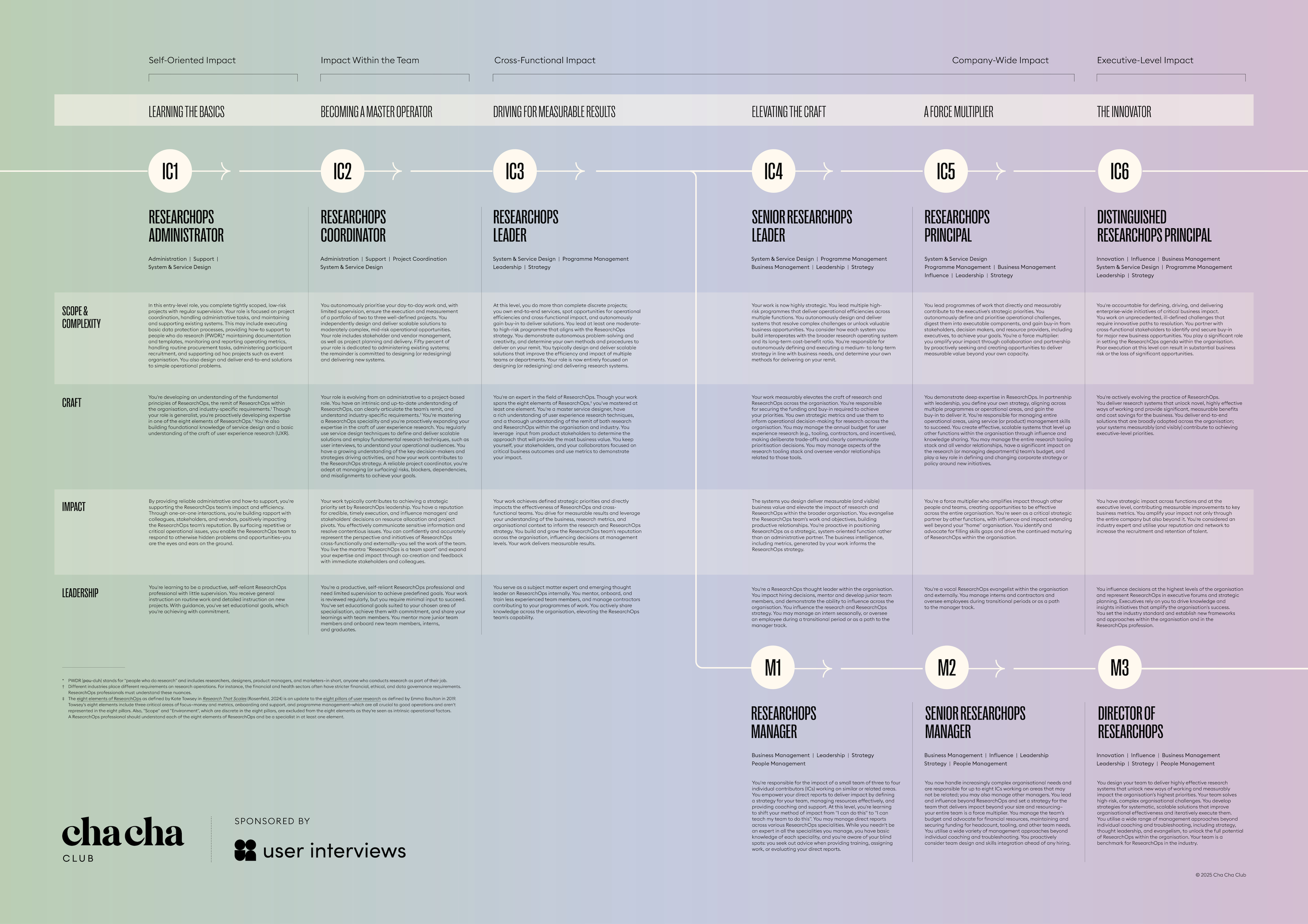
Download The Universal ResearchOps Career Ladder as a PDF or print it out. It is detailed, so you’ll need to get it professionally printed at A0 size.

But before you dive in, read on. I’ll share what a career ladder is, why the Ladder is an essential asset now more than ever, why this ladder is universal—a useful asset, whatever your team size, industry, or ResearchOps specialty—and how to use it as a springboard to create a ladder that’s custom-fit.
As a bonus, you’ll also get a sneak peek at some of the data and quotes from User Interviews’ forthcoming report, The State of Research Operations 2025, which will be published in December 2025.
But What’s a Career Ladder?
If you’re wondering, “But what’s a career ladder?”, wonder no more. In her recent article for The ResearchOps Review, “License for Maximum Impact: The Power of a ResearchOps Progression Framework”, senior ResearchOps leader, Saskia Liebenberg, put it best:
You might call this [a progression framework] a career ladder, performance matrix, skills framework, job architecture, or level document. In short, it’s a tool managers use to evaluate what success in a role looks like, and how to level their team members. And, of course, it’s also used to evaluate whether someone should be promoted (or not), which makes it an important asset for employee growth, especially when the role is niche.
ResearchOps is a niche role, and it’s evolving quickly. So quickly, in fact, that managers and hirers could be forgiven for not keeping up with the core competencies (skills, knowledge, and abilities) required to do the job well, let alone what good ResearchOps looks like. So, how has ResearchOps evolved?
From Administrators to Sophisticated Operators
Over the past fifteen years, ResearchOps has gone from scrappy teams of one focused mainly on administrative tasks to the point people delivering sophisticated research operating systems. While teams of one still predominate—according to data from User Interviews’ upcoming report, 41% of respondents with a ResearchOps function said they had one dedicated team member, 31% had between two and five, 17% had between six and 19, and 11% had 20 or more—the nature of the work has fundamentally changed. ResearchOps teams of all shapes and sizes are now less focused on administrative tasks and more focused on systems and service design, and business (or product or service) management. This quote puts it perfectly:
We are no longer just talking about scheduling interviews and sending out emails. Instead, we are seeing a focus on managing research programs, with a lot of service design and product management skills being required for these roles. This change from past roles makes me believe that we are moving towards a greater emphasis on management skills in these positions, rather than just the operational tasks typically handled by interns and junior-level employees.
—The State of Research Operations 2025 by User Interviews
With the focus on low-impact clerical tasks almost a thing of the past,1 mature ResearchOps professionals are instead designing and delivering systems that impact dozens or hundreds of people. As a result, they’re gaining the buy-in they need to grow their careers and their teams, and they’re trailblazing ResearchOps manager, senior manager, and even director or VP-level ResearchOps roles, whether as individual contributors (ICs) or as people managers. As part of this evolution, many ResearchOps leaders are, for the first time, learning how to hire, who to hire, and how to structure and advocate for their team.
In the midst of an economic downturn, this is all good news. But the speed and busyness of this evolution has meant that many ResearchOps professionals haven’t had time to define a career ladder, or a satisfying one, to guide their and their team members’ professional growth.
I don’t quite know where I’ll be in five or ten years’ time because I don’t see a career path that’s been clearly carved out for me.
—The State of Research Operations 2025 by User Interviews
Add to this the growing stature of ResearchOps, which means many companies are hiring their first ResearchOps team member—great news again—but with limited resources to refer to, they’re playing guesswork as to who to hire, when, to do what, as evidenced by the countless laundry-list job descriptions!
I wanted to change this (both the laundry-list job descriptions and the lack of a clear career path), so I teamed up with User Interviews and, with contributions from a crew of Cha Cha Club members, created The Universal ResearchOps Career Ladder. Now, whatever your team size, industry, organisation type, specialism, country, or ResearchOps expertise, you have a springboard from which to create a ladder that’s custom-fit, or to use as is, if your organisation allows it.
Using the Ladder as a Springboard
While researching The Universal ResearchOps Career Ladder, many of the ResearchOps ladders I reviewed2 included craft layers for the ResearchOps elements,3 such as participant recruitment, knowledge management, or ethics and privacy, as a requirement across multiple levels.
To retain the universality of The Universal ResearchOps Career Ladder, I chose not to list particular ResearchOps elements as a requirement at any level and instead described core ResearchOps competencies that can be used to manage performance whatever the employees specialism. This not only makes the Ladder universal across companies and countries, it also makes it universal across the variety of people that comprise a dynamic, articulate ResearchOps team.
Should you use the Ladder as a springboard to create your own career ladder for ResearchOps, I recommend you retain this universality. Here’s why: As your team grows in size and sophistication, you may hire people with deep expertise in one element, like knowledge management, communications, or finances, as I’ve done in the past. These people are unlikely to require deep expertise in other ResearchOps elements to succeed in their role, so an overly specified ladder won’t represent their journey or stand the test of time as your team evolves. In short, your ladder should be specific enough to guide growth across specialities, but not so specific that you need multiple complex ladders, or constant iterating, for it to remain an accurate reference for performance and growth. Keep this principle in mind as you customise The Universal ResearchOps Career Ladder to help your ResearchOps team thrive.
Share Your Feedback
If you would like to share feedback about the Ladder, please leave a comment.
Brought to You By

User Interviews—the only solution you need to recruit high-quality participants for any kind of research.
Credits
The Universal ResearchOps Career Ladder was produced by Kate Towsey, with contributions from the following Cha Cha Club members: Wyatt Hayman, Saskia Liebenberg, Rodrigo Dalcin, Jared Forney, Lauren Galanter, Caitlin Faughan, Stephanie Marsh, Stephanie Kingston, Kalee Dankner, Leah Kandel, Jamie Williams, Jenna Lombardo, Christen Penny, Luana Cruz, Alma Krezla, Carolyn Morgan, Lydia Iana, and Rebecca Dennigan.
These articles were a valuable reference:
“Career Ladder from Junior to Director—Guidance for UX Professionals” by Jing Jin, Bootcamp
“License for Maximum Impact: The Power of a ResearchOps Progression Framework” by Saskia Liebenberg, The ResearchOps Review
“Defining UX-Career Progression: What Practitioners Say” by Rachel Krause, NN/g
“The 5 Stages of UX-Career Progression” by Rachel Krause, NN/g
Every system creates administrative overhead that must be planned for to keep the system running. But instead of ResearchOps being hired to handle administration, ResearchOps are now being hired to build low-administration systems, then find ways to administer them, which might involve hiring administrators into entry-level roles.
Eight Cha Cha Club members shared their career ladders privately in the members-only Slack.
Pick up a copy of my book Research That Scales (Rosenfeld, 2024) to learn more about the eight elements of ResearchOps, how they interplay to form The Venn Diagram of ResearchOps, and why this understanding is crucial to delivering scalable research operations.
 | A guest post by
|