

From Red Flags to Green Lights: How to Turn Misaligned Research Requests Into Partnership Opportunities
by Emily Taylor

Subscribe to get sharp thinking all about ResearchOps delivered straight to your email inbox. It’s free!

The ResearchOps Review is brought to you by Rally—scale research operations with Rally’s robust user research CRM, automated recruitment, and deep integrations into your existing research tech stack.
Imagine a hypothetical scenario in which a research team receives a request to conduct a study aimed at informing a stakeholder’s marketing plan. The stakeholder explains that they’d like the research team to conduct fifty in-person interviews, with the final results delivered within two weeks. The goals of the study are to measure audience size and brand awareness, understand brand perception in context to competitors, test new prototypes, and explore where end users seek information to find similar products. Seems straightforward enough, right? Well…aside from a few red flags:
Mixed methodologies. Some of the goals are quantitative (metric-based), but they also requested qualitative research (in-depth interviews, topic exploration, prototype tests).
Missing context. Apart from requesting both quant and qual methodologies, they’re looking for learnings from a significant number of interviews (fifty), without any context as to why.
Inadequate timing. The turnaround time is infeasible; they haven’t considered timing for the project’s kickoff, design, participant recruitment, analysis, reporting, and more.
If you regularly receive research requests from stakeholders, this scenario is likely less hypothetical and more familiar. Some stakeholders don’t understand what makes a successful research project, well, successful. Because they’re not steeped in the research discipline, they often require guidance as to what the most effective or efficient methodologies are, how to appropriately scale and scope a project, what the process itself entails, why it’s important, and how a good research process amplifies the return on their research investment. Navigating the type of guidance you give as a research operations professional and how you handle these conversations is critical. If it’s not handled the right way, research (the process and the team) can come across as unapproachable—too complicated, expensive, and slow.
If you work in research or ResearchOps, I’m sure you’ll agree that balancing stakeholders’ needs with processes and boundaries, while ensuring practitioners aren’t overwhelmed and overworked, is a major challenge. In this article, I’ll share the ResearchOps strategies I’ve used to strike that balance. I work as a Director of Operations in an agency context, but the learnings I’ll share are equally applicable if you work in-house.
Managing Misalignment
Our research request scenario, with all the red flags, looks like a challenging project from the outset. I’ve seen a few tactics used to respond to outsized and misshapen research requests: some that foster partnership and some that chase stakeholders away. Let’s start by looking at the latter.
The most straightforward (and least ideal response) is simply to turn down the work and label the project as infeasible—or explain what is feasible but with little or no context as to why the rest can’t be done. This kind of response will likely cause the prospective partner some frustration and confusion, and lose you the business if you’re an agency, or the opportunity to build productive partnerships if you work in-house. Instead, I’ve learned to try to see the request as alignment in progress.
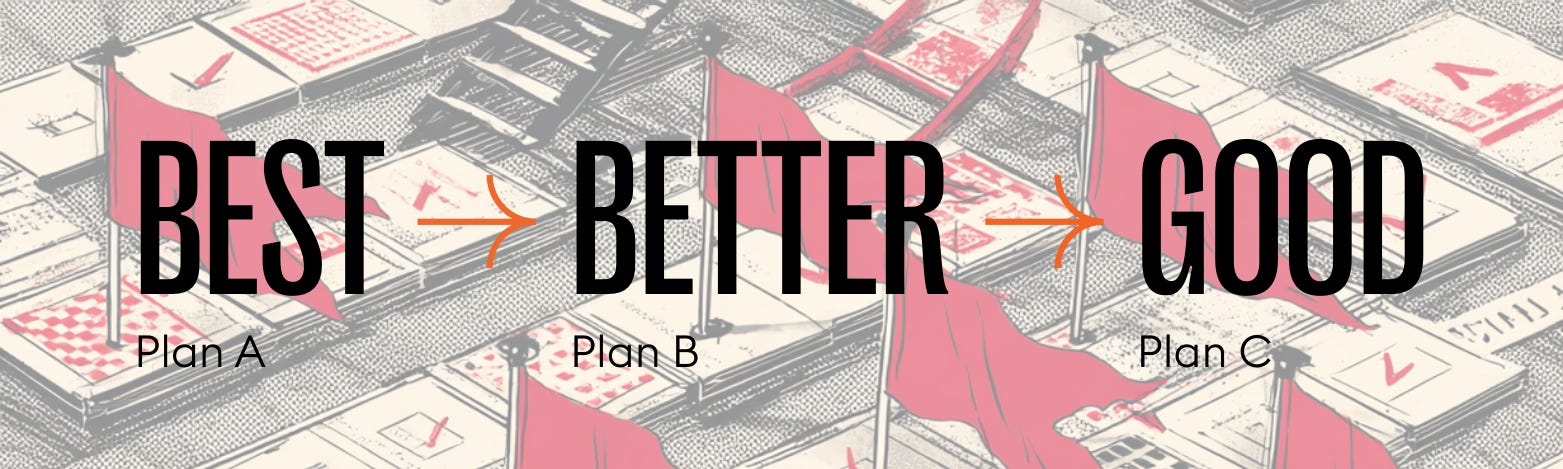
Budget and time constraints are common sources of misalignment. Typically, stakeholders and people who do research (PWDRs) alike want larger research budgets, and they want the insights they need delivered yesterday. But rather than explaining how the request could be clearer and more productive, researchers need to take the time to learn more about stakeholders’ goals, objectives, and timeline—and provide guidance for how to make the project more approachable for the people doing the research, while also setting the stakeholder up for a successful experience. You might also offer tiered recommendations: “best: plan A,” “better: plan B,” and “good: plan C” (see Figure 1).
By habitually taking an approach of proactive alignment, PWDRs can foster an understanding that stakeholders are doing the best they can with the information they have and vice versa. Rather than making assumptions or leaving stakeholders feeling ineffectual or confused, researchers can build relationships and educate stakeholders about good research practice. As a result, PWDRs can expect more consistent and effective requests in the future, and red-flag scenarios can become opportunities to deliver value and a positive experience. Even with a limited research budget and timeline, there’s usually an opportunity to think about (and negotiate) a feasible approach.
I call this crucial shift from a guarded or protective mindset to one that prioritizes alignment, the approachability mindset. While a mindset shift sounds easy, it doesn’t happen overnight—or on its own. But cultivating processes, habits, and culture that support PWDRs in proactively managing misalignments creates space for everyone to win.
Building Approachability Into Your Operations
Every research project can be a dream project by adopting an approachable mindset. Sounds great, right? But what does an approachability mindset look like, and how do you put it into practice? There’s popular yet somewhat stale advice out there that lacks nuance if your goal is to create lasting and transformative change.
The popular advice is to consider all the steps in your organisation’s research process and how you might standardize them. You can do this by involving PWDRs and stakeholders in a brainstorming session to understand the ideal research process, then create a roadmap for them to review and confirm (or negotiate) alignment. The goal is to confirm the expectations of core milestones within the market research process, what success looks like for a project, and the ideal study timeline from start to completion. Finally, you’ll build processes around this map.
Now, while doing this work is important, there’s a common pitfall that prevents process creation, and importantly, adoption. And, if everyone is paying attention, it will likely come up in your brainstorming sessions: the belief that every research project is too custom and unique from another, and that there’s no way to standardize the processes around them.
Consider these two examples:
You’re doing research in the medical field and need to conduct five in-person interviews to test new software for patient portals: a website or app for patients to access health information, such as results, communication with providers, and bills.
You’re running an online survey with 1,000 respondents to measure brand equity for a consumer packaged goods (CPG) brand.
These projects have completely different objectives, methodologies, and deliverables; as a research or ResearchOps professional, the many ways they differ are obvious. Developing an approachability mindset means we’ve got to shift our perspective to identify how these projects (and how all the other sorts of projects you regularly do) are similar, then create templates, processes, and document workflows that support those similarities, making research more approachable, systematic, and sustainable.
Approachability In Practice
As mentioned, I’m a Director of Operations in an agency context, so my work involves a significant variety across clients, methodologies, topics, and participants. My team has documented our unique processes and workflows from kickoff to completion. For example, we’ve created a research principles document which outlines our approach to client management from kickoff to completion, includes timelines and checklists for each step, and templates for key touchpoints (documents and corresponding email text). Having this document, along with supporting resources and templates, has ramped up our onboarding process by 50 percent. By adopting an approachability mindset, we’ve also been able to grow our client portfolio (with typically around half of our projects leading to returning clients), increase project size by two to five times, and stabilize workload efficiency across our research team.
Here are some of the steps in the market research process that we’ve standardized:
Preparing for stakeholder or client meetings. Set up PWDRs for success by providing basic tips, guidelines, checklists, and a list of questions that need to be answered at the outset.
Setting ideal timelines for each step of the research process. Provide a map of the most common steps, along with average or projected timelines and important aspects or milestones to consider at each point.
Determining what to share at key touch points. Provide templates that establish a baseline for what information should be (or not be) included at key touchpoints, such as fieldwork progress, and even include reminders to send information updates. You might also include guidelines on how to position information and any nuances to consider.
Preparing for an internal review. Provide an outline of the basic steps PWDRs should take to conduct an internal review before deliverables are shared with the client. This sort of preparation can help PWDRs build in capacity for more strategic value-add work, such as additional summary content or high-impact visuals.
Sharing deliverables with a client. Provide a checklist of considerations PWDRs should review before sharing deliverables with clients—reminders that may help PWDRs feel more at ease when delivering insights. This could also include checklists for research design, programming, data cleaning, reporting, and presentations.
Remember, it’s not about following these processes and practices exactly for every single project. In fact, it’s better to allow for some variations; the goal is for PWDRs to consider the ideal process, and embrace an approachability mindset to navigate the nuances of each project.
Embodying Approachability
Embodying an approachability mindset brings the value—and the impact—of research into clear view, swiftly. When research professionals and projects are approachable, stakeholders not only see how effectively (and efficiently) their objectives can be met, they also tend to feel more invested in and trusting of the process. As a result, practitioners can spend less time architecting buy-in strategies and more time doing the quality work they are trained for. And stakeholders become true partners and advocates for the work.
Sponsor and Credits
The ResearchOps Review is made possible thanks to Rally UXR—scale research operations with Rally’s robust user research CRM, automated recruitment, and deep integrations into your existing research tech stack. Join the future of Research Operations. Your peers are already there.

Edited by Kate Towsey and Katel LeDu.
 | A guest post by
|